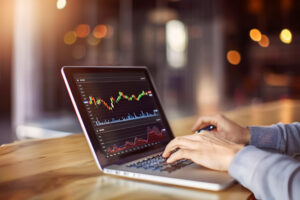
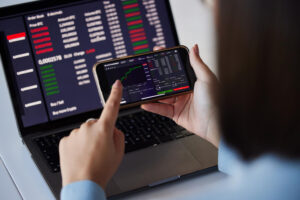
Instead of placing orders through a traditional broker by telephone, traders can use an internet connection and digital tools to buy or sell financial instruments from almost anywhere. Today, online trading covers a broad range of markets and approaches, making it accessible to both experienced market participants and people who are learning how trading works.
The basic principle is relatively simple. A trader chooses a financial market, analyzes its price development and decides whether to open a position based on an expectation about future price movements. However, successful trading requires considerably more than predicting whether a price will rise or fall. Market knowledge, analysis, discipline and risk control all play important roles.
For this reason, trading for beginners should start with education rather than the pursuit of quick profits. Understanding how markets behave, how orders work and how losses can be controlled creates a stronger foundation for making informed trading decisions.
How Online Trading Works and Which Markets You Can Trade
Access to financial markets is generally provided through a trading platform, where users can view prices, analyze markets and place orders. Depending on the provider and available products, traders may have access to currencies, stocks, commodities, indices, cryptocurrencies and other financial instruments.
Forex trading focuses on currency pairs, such as EUR/USD or GBP/USD. Currency prices can react to interest rates, inflation, economic growth, central bank decisions and geopolitical developments. The foreign exchange market attracts different types of traders because of its liquidity and extensive trading hours.
Stock trading, by comparison, involves exposure to individual companies and is influenced by factors such as earnings, industry developments and broader economic conditions. Gold trading provides access to one of the world’s best-known commodities, while crypto trading focuses on digital assets and can involve substantial price volatility.
Trading styles can also differ significantly. Day trading generally involves opening and closing positions within the same trading day. Swing trading typically involves holding positions for several days or longer in an attempt to capture broader market movements. The appropriate approach depends on a trader’s objectives, available time, experience and tolerance for risk.
Trading Charts, Indicators and Market Analysis
Analysis is an essential part of online trading. Before entering a position, traders often evaluate historical price movements and current market conditions to identify possible opportunities and risks.
Trading charts visually represent price development over a selected period. Candlestick, line and bar charts can help traders identify trends, price ranges and changes in market momentum. Chart analysis is frequently combined with trading indicators, including moving averages, oscillators and volatility-based tools.
Technical trading analysis examines historical price and volume information to identify patterns that may provide information about future market behavior. One commonly used method is support and resistance trading, which focuses on price areas where buying or selling activity has previously increased.
Some traders also use trading signals generated by analytical tools, algorithms or third-party services. Signals can highlight potential opportunities, but they should not replace independent analysis. No signal can reliably predict future price movements, and market conditions can change rapidly.
Fundamental analysis provides another perspective by examining economic data, company information, monetary policy and other factors that may influence asset prices. Combining several analytical methods can provide broader context before a trading decision is made.
Trading Strategies and Building a Trading Plan
Consistent decision-making is one of the central principles of online trading. Rather than entering positions randomly, traders can establish trading strategies that define the conditions under which they will consider buying or selling an asset.
A trading strategy may be based on trends, momentum, breakouts, price patterns, fundamental developments or a combination of several methods. There is no single strategy that is suitable for every trader or every market environment. A method should reflect the trader’s objectives, time horizon and willingness to accept risk.
A written trading plan takes this process further. It can define which markets will be traded, preferred entry and exit conditions, maximum position sizes and circumstances in which trading should be avoided. Establishing these rules before entering the market can reduce impulsive decisions.
Modern technology has also introduced alternative approaches such as copy trading, where users can automatically replicate certain trades or strategies of other traders. While this can simplify some aspects of market participation, it does not remove risk. Previous performance does not guarantee future results, and traders should understand the strategy and risks before allocating capital.
Testing a strategy using historical data or a demo environment can help identify weaknesses before real money is involved. Results should then be reviewed regularly because market conditions and the effectiveness of particular approaches can change.
Risk Management, Trading Psychology and Getting Started
Risk control is fundamental to sustainable online trading. Effective risk management trading practices focus on limiting potential losses rather than attempting to make every transaction profitable. Traders can use position sizing, stop-loss orders and predefined risk limits to control how much capital is exposed to an individual trade.
Leverage requires particular attention. It can increase market exposure with a relatively small amount of capital, but it can also amplify losses. Understanding leverage, margin requirements and potential downside is therefore essential before trading leveraged products.
Technical knowledge alone is not enough. Trading psychology can have a major influence on decision-making. Fear may cause a trader to close a position prematurely, while greed can encourage excessive risk. Developing a disciplined trading mindset can help traders follow predetermined rules even during periods of volatility.
Beginners can start by learning basic market terminology, understanding order types and practicing analysis before committing substantial capital. A demo account can provide experience with platform functions and order execution, although simulated results do not fully reproduce the emotional and financial pressures of trading with real money.
Ultimately, online trading should be approached as a skill that requires education, practice and continuous evaluation. Different markets and strategies provide many opportunities, but they also involve the possibility of financial loss. Traders who combine structured analysis, a clear plan, disciplined risk management and realistic expectations can build a more systematic approach to participating in financial markets.